
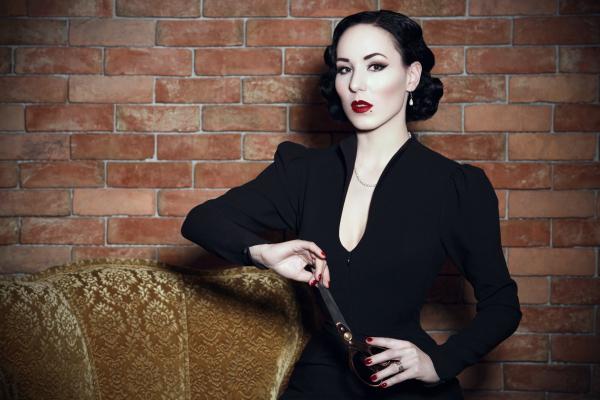
Corset Maker – that’s the intriguing title of the fashion designer who goes by the name Riwaa Nerona. Her studio on Husitská Street in Prague, bathed in warm, dark colors, is equally intriguing. Mannequins stand along the walls, wearing corsets, corselets, garters, and robes—some with lace, some without… My first encounter with Riwa took place via Facebook, though it wasn’t exactly warm. Her replies were terse, as if shyness were holding her back. I convinced myself she’d had bad experiences with men, a belief reinforced by the fact that her company website didn’t list a phone number. A personal visit, however, dispelled my fears. From her initial wariness, the corset maker in a black cocktail dress that accentuated her wasp waist and with an Evita Perón hairstyle transformed into a smiling hostess who even poured red wine. My knees stopped shaking, the goosebumps disappeared, and my face regained its normal color. I was finally able to squeeze out my first question.
What types of corsets (laced bodices) do you design and manufacture?
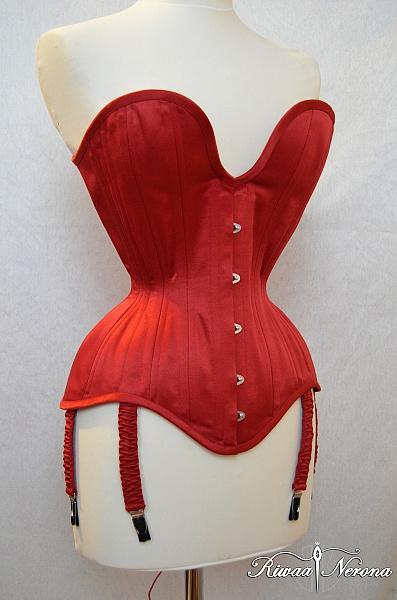
These are custom-made corsets for clients, which I design according to their appearance, proportions, and intended use. I don’t generalize based on gender, so I sew for both men and women and even these models are essentially similar, just made to different proportions. Most often, I create models for everyday wear as undergarments, or costumes for burlesque dancers and formal occasions. Very rarely, I also work on historical corsets, without which the costume silhouette of bygone eras would not be complete. I also design lingerie, specializing in functional garter belts.
Which is more common? Interest in corsets for burlesque dancers, drag artists, dominatrixes, or everyday wear?
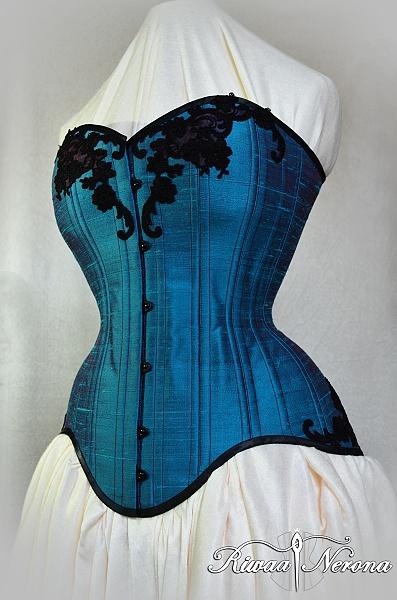
The most “visible” clients are burlesque performers, for whom I create intricate corsets full of hand-embroidery and featuring significant waist cinching (tight lacing). Otherwise, I make a lot of standard styles that serve as undergarments—meaning they’re not worn over clothing but underneath it—to cinch the waist. In the past, it was quite common for clients to want to achieve the narrowest possible waist (so-called waist training) and count every centimeter. Now, clients are more interested in the feeling than in the performance. It’s a huge change from when I first started. We’ve entered an era where people want to enjoy the possibilities that corsets offer them.
During an interview with a well-known drag group, I learned that they had a set of corsets custom-made, but it started falling apart after just their second performance…
That can happen. Not all corsets are created equal. There is a model made according to the corset-making craft, which requires extensive training and is also quite physically demanding to produce. The point is for it to last a year or two, or even longer, with regular wear. In another salon, the production technology may differ in many ways. They use different reinforcements, different boning, different fabrics, different layering, different lacing…
So that’s why you have orders booked a year in advance. You devote yourself thoroughly to the craft… You sew the model several times so it will last for a while… In your case, it’s not about making it in five minutes, but about making it with quality, which takes you five or six hours of work…
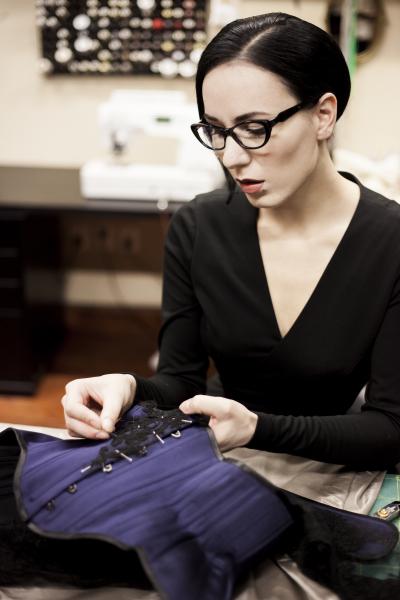
Well, add that up. Production usually takes thirty hours, including sewing a test model from canvas so the client can try out the feeling of the cinching. I try to design corsets so that they cinch only at the waist, while the rest of the body is simply shaped and hugged. It’s not possible to try on the models I have on display here in the studio. For one thing, they’re tailored to me—for a different waist and different proportions. I’ve actually been an active corset wearer for over nine years myself.
For occasional wear, however, you can also purchase a ready-to-wear corset; when doing so, choose it not based on the waist measurement you wish to achieve, but according to the upper and lower circumferences. Very often, when choosing a smaller size to achieve a tighter waist, the wearer ends up constricting the entire torso, which is undesirable not only for the body but also aesthetically.
How many fittings does a client need to go through?
There may be several. But the main one is the first, which lasts about an hour and is more of a consultation. We discuss the material, cut, purpose of wear, what clothes the corset will be worn with, and what their wardrobe looks like. This is followed by the production of a trial model made of very sturdy canvas. Although such a corset is stiffened with plastic boning, we can still determine whether it is comfortable for the client and fits well. With corsets, the cut is what matters most. The boning adds to its durability. Only then does the actual sewing take place, followed by “training” on how to handle it. Of course, I also teach how to lace it up and how to care for it.
So you’re a true expert. That probably isn’t cheap…
Everything is described on the website. It starts at three and a half thousand crowns, including a consultation and the creation of a prototype, and the price increases depending on the complexity of the design. Usually the final price is around four to five thousand crowns. In the case of an elaborately decorated corset, the price can easily exceed ten thousand, depending on the components used.
How did you get into corset-making?
I sewed my first corset for myself using instructions I found online. And since it turned out well, my friends started asking me to sew for them too. I then registered my business and began taking custom orders. It was a long process. I’ve been working as a corset maker for nine years now.
I assumed you went to school for that?
The truth is, after high school, I took a three-year distance learning course at a fashion school, but sewing corsets definitely wasn’t part of the curriculum. Of course, schools teach the construction of corset bodices for formal wear, but that has little to do with corsets as such. A corset is shapewear, and even if we design it as outerwear, it still retains a touch of lingerie-like allure, and that is what makes it so seductive.
From the very beginning of my work, I’ve also been sewing for men, even though men’s versions and their wearing are considered taboo. However, interest is growing, and some examples can be seen on my website.
And be careful: don’t confuse corselets with corsets. A corselet is a combination of a garter belt and a bra.
This brings us to accessories. You also design garters. Isn’t that a bit retro?
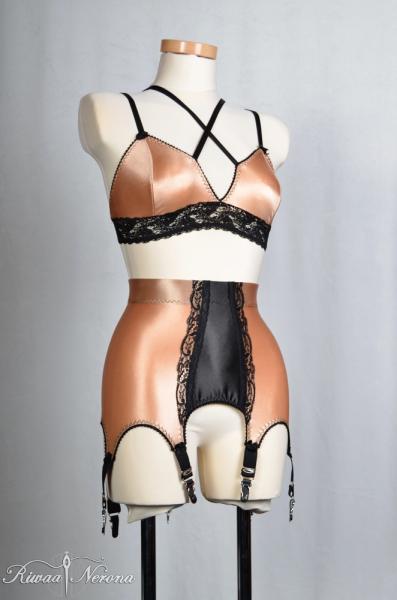
Not retro at all! Ladies have brought skirts back into their wardrobes, and therefore need stockings for warmth or for aesthetic reasons (not just women, but many of my clients are men who wear garter belts and stockings even under pants). My work isn’t meant to celebrate retro style, even though garter belts began appearing as early as the First Republic era. I don’t aspire to copy history, but I draw on historical knowledge.
A garter belt is a fully functional piece of lingerie that, as a bonus, makes you feel seductive. And everyone knows how much a stocking can accentuate the delicate curves of the legs. Why are garter belts considered erotic? Look at the difference between when a woman puts on pantyhose and when she puts on and takes off a single stocking.
Most burlesque performers wear headbands with ostrich feathers. As I was told, this is a type of accessory known as a headpiece…
That’s right. For the L'Amour Night event, I created a “headpiece” collection, but only for my models' performances. I don't plan to pursue this line of work. There are far more skilled creators in the Czech Republic. Not to mention that it’s an expensive endeavor.
Have you counted how many finished corsets you have to your credit?
Approximately around six hundred, if I count the attempts as well, especially in the early days of sewing them.
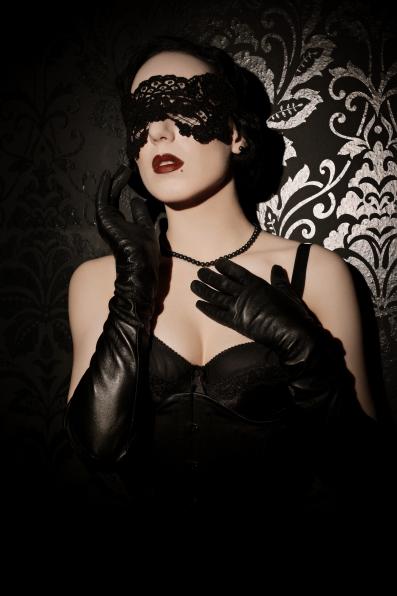
Your real name has been replaced by the stage name Riwaa Nerona. Where did you come up with it?
I like the color black which is why I chose the surname Nerona, and Riwaa is a name I made up entirely on my own.
Do you participate in shows?
Yes, but I also have to limit my participation somewhat. Moreover, I’m moving away from traditional shows and instead try to create entire themed scenes. For example, I had the opportunity to participate in Prague Fetish Weekend (a show called CVLT), another Other Dress (Zhýralí), and most recently I modeled at an event called L'Amour Night (You Want It Darker).
I attended the last-mentioned event as a spectator. It was a varied program featuring burlesque dancers, singing, unconventional hosting, and a mysterious show performed by your studio’s troupe. Where did you get your inspiration?
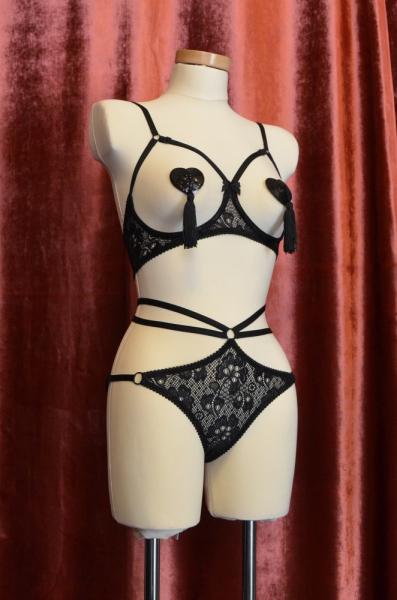
Mainly from China, Tibet, and India—their temples. Overall, the show had a subtly oriental vibe… During the four-minute performance, it was necessary to present several outfits to the audience: four negligees, under which you could see a corset, a bra embroidered with faceted beads and appliqué stones, complemented by a garter belt, another model wore a lace bodysuit with a rose motif, and the boldest of all was the “open bra” model—a cup-less bra made of luxurious embroidered tulle, complemented by panties and pasties made of the same material. I myself appeared in a “tight lacing” underbust corset, which was paired with a strapless bra. Both pieces were adorned with appliqués made of embroidered tulle, from which a headpiece inspired by a Spanish mantilla was also crafted. I adorned my fingers with long claws, which were the work of my husband. The entire show was complemented by designer stockings from timea.cz.
It was an interesting mix. Just think of the colorful scene changes, the glowing candles, some models strutting down the runway in high boots above the knee… How long does it take to prepare a show like this?
We usually meet with the Muses six times. At the first rehearsal, we discuss the concept of the performance and the music selection. Then we rehearse the choreography, first without costumes and then with them.
Now come clean. How many audience members in the hall did you have on your side? Your performance was accompanied by loud whistles and unceasing applause…
The audience’s support was amazing, and we were so pleased by the huge applause. Of course, we’re all in the same industry, so it’s safe to say that all the performers know each other. But I definitely can’t imagine us paying our own team to be the audience 😀 Thank you so much for such great support, and we’ll try to surprise you with something again next time.
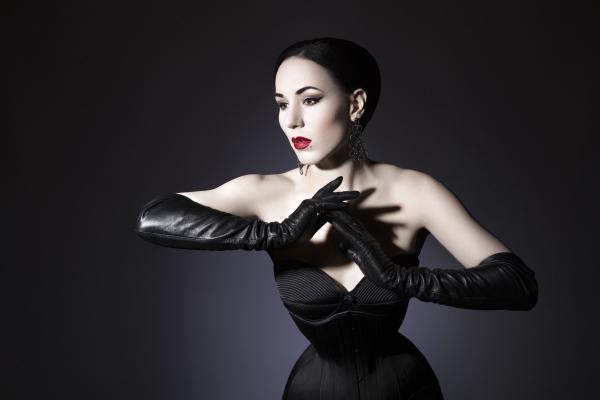
You were the main partner at the first edition of this spectacular event. How would you rate the second edition?
It was much better,in terms of the program, high attendance, and the number of exhibitors. The event provided a pleasant experience of walking the runway, new contacts, and greater awareness of the exhibitors’ products.
By the way, you presented your studio with your own booth. What effect did that have?
I was in contact with clients. That always inspires me to create more. I also enjoy not only talking to people about the products, but also discovering their secret wishes and thereby enriching the collection. Of course, my lingerie is primarily about the feel; everyone could try it on without obligation and, above all, touch the material, which I always welcome.
Do you like wearing corsets yourself?
Yes, I do, and basically as underwear. Wearing tights with a corset is very impractical, which is why I choose stockings. The feeling in them is amazing; I feel elegant in them. This lingerie requires a different style of sitting, walking, and moving in general, and above all, an elegant skirt length that reaches at least to the knees. I’ve always loved lingerie, luxurious materials, and the feel of lace directly against the skin. Simply put, everything that emphasizes sensuality by concealing while revealing.
Much has been said online about the history and significance of corsets (laced bodices). However, why not recall a few historical facts? The predecessors of today’s corsets were reportedly found as far back as ancient times, mostly in the form of cinching belts in Minoan culture. During the Renaissance, particularly in France, the first so-called “boned bodices” were created. Even the queen of that country, Catherine de’ Medici, introduced this fashion at court. This was supposedly to suppress the natural curves of the ladies-in-waiting, as this period favored very small busts. Generally speaking, the corset was seen as protection for the waist due to the large number of heavy skirts and also contributed to shaping the décolletage. However, when discussing the corset with hooks and lacing at the back, we must go back to the mid-nineteenth century and pay tribute to the designer Jean Julien Rosselin. From that time on, corsets of this type began to be mass-produced. However, they were not of the highest quality, due to the cheap and low-grade steel used, which could cause injury to the wearer… Garter belts followed, which were attached to the corsets to make wearing stockings easier. When corsets fell out of favor, garter belts took center stage.
Riwaa Nerona is constantly on the go. She is well aware that if someone wants a corset made directly by her, she is honored by it, and at the same time, it is a sign that she is doing her job well. Moreover, she doesn’t copy anyone; everything has an original design. Just take a look at her portfolio: riwaa-nerona.
Photography: Danny Worm Photographer, Lucie Baldé, Lucie Kout, and Riwaa Nerona


Your opinions 2 opinions
Vždycky sem si chtěla koupit nějaký korzet, protože můj přítel na ně má slabost. Ale ještě jsem nenašla takový, aby byl pohodlný a zároveň sexy. Škoda, ale budu hledat dál, co bych pro svého přítele neudělala že? Jaký se konkrétně líbí vám?
Hezký den,
pokud se nepletu, tento dotaz jste měla na paní Riwu. Prosím kontaktujte přímo ji na jejím webu.
Děkuji a přeji krásný den.
Wow, nádherná práce a nádherná korzetiérka – snad i hezčí než Dita Von Teese (a že jí je pěkně podobná). Díky za rozhovor = více takových…
Zdravím,
děkujeme za pochvalu 🙂 Na dalších rozhovorech usilovně pracujeme 🙂